Science
Western astrology, Vedic astrology and Chinese BaZi developed in different places, from different traditions, with different ways of interpreting time.
Astrum doesn’t blend them into a single answer. It calculates each independently, places each against the same life, and keeps watching.
Because the interesting question isn’t simply what does my horoscope say? It’s: what did the system say — and what did my life actually do?
Three systems
Each remains its own system, with its own calculations, timing and traditions.
Sometimes they point toward the same period. Sometimes only one does. Sometimes they disagree.
Astrum keeps the disagreement.
The record
Astrum builds a longitudinal record from the events and experiences you choose to record. Career changes. Relationships. Moves. Losses. Beginnings. Endings. Dreams. Turning points. Ordinary months and extraordinary ones.
That record matters because Astrum isn’t interested only in whether an interpretation sounds right. It wants to know what happened.
And it keeps the two things separate. What the system said. What your life recorded. Only then does Astrum compare them.
Before, not after
Each monthly reading is generated before the month it describes and preserved. Afterward, you can return and mark how it landed:
Spot on · Partly · Off
The original reading doesn’t change.
That creates something fundamentally different from a horoscope read after the event: a record of what was said before anyone knew what the month would contain.
Over time, those records accumulate. One prediction becomes an observation. Many observations become something that can be tested.
Two ways of looking
Your rating is useful — but Astrum doesn’t rely on your rating alone. It can also compare a system’s timing with the events recorded in your life.
That distinction matters. A reading may feel accurate. The separate question is whether the periods it identified actually differ from other periods in your record.
Astrum keeps those questions separate.
How Astrum tests it
Astrum doesn’t compare your experience with a population of strangers.
It compares periods within your own life.
If a reading identifies certain months as unusually demanding, Astrum can ask whether those months actually carried more change than other months in your record.
A difficult period in one person’s life may look completely different from a difficult period in another’s.
So the question isn’t whether your life resembles everybody else’s.
It is whether the pattern described by the system appears in yours.
Beyond a hit rate
Simply counting how many readings were marked spot on isn’t enough.
Test enough possible patterns and eventually something can look impressive simply because there were many opportunities for a match.
Astrum runs two tests, and each one accounts for its own search. The ratings test reshuffles the data inside your own record 2,000 times and asks how often chance alone could produce a result at least as strong as the one observed. The dated-event test raises its bar for every reading it tested.
The test must account for the search that produced the finding.
They ask different questions, so they can disagree. Each result below says which test produced it.
Sometimes a pattern holds up. Sometimes it doesn’t. Astrum keeps both.
An example · the ratings test
These figures come from the demonstration record shown throughout this site. The record is fictional; the calculation is real.
The widest separation produced by any reading was 27 points. Under Astrum’s permutation test, chance produced a gap at least that large about eleven times in a hundred.
The evidence was insufficient to distinguish the result from chance. So Astrum said so.
When there is nothing · the dated-event test
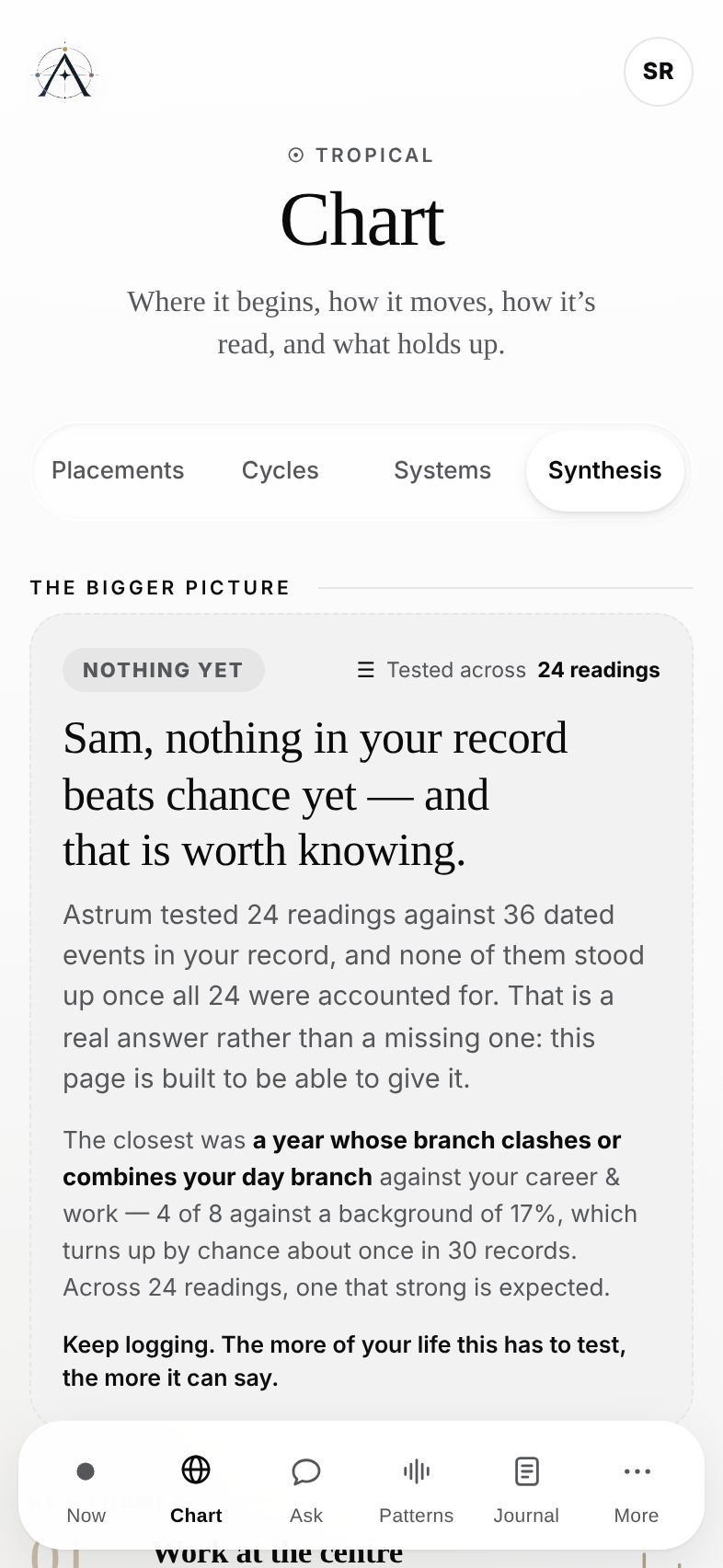
The dated-event test asks a different question of the same record, and answers it separately. Twenty-four readings were tested against thirty-six dated events here, with the bar corrected for every reading tested.
None produced sufficient evidence of separation from chance.
So Astrum reported exactly that.
A result doesn’t have to be positive to belong in the record. As more of your life is recorded, the evidence can strengthen, weaken or remain inconclusive.
Life change
Astrum also uses the events you record to build a picture of how much change different periods of your life carried.
Gain and strain remain separate. A year containing major positive change and major difficult change isn’t treated as though the two cancel each other out.
And when Astrum doesn’t have enough information to measure a period, it reports it as unmeasured, not zero.
Because an unknown year isn’t necessarily a quiet one.
The Life Change Score is a self-tracking measure of the change represented in the events you record. It is not a measure of health or wellbeing, and it does not assess health.
The index does not replace medical advice. Weights adapted from Wallace, Cooper, Sel & Russo (2023), PLOS ONE 18(12): e0295943, under CC BY 4.0. Changed: weights only, applied over entries Astrum classifies itself and scored against your own record.
Over time
As your record grows, Astrum gains more periods to compare, more cycles to revisit and more opportunities to ask whether something that appeared once appears again.
A pattern can survive. A pattern can disappear. Different systems can disagree.
The purpose isn’t to prove that Western astrology, Vedic astrology or BaZi is right. It is to keep the prediction, keep the life, and see what survives when the two are compared over time.
Many systems. One life. Tested.
Get Astrum